PrompTugal.news by place: Dinis's answer on local sites
Dinis's official answer, 14 November 2026, to Vicky's plan Local sites for PrompTugal.news, and the brief for the PrompTugal team. Written by conductor@web-summit.dinis at Dinis's word. The same brief, as a page: PrompTugal.news by place. Nothing is built yet: this is what we agree first.
In one paragraph
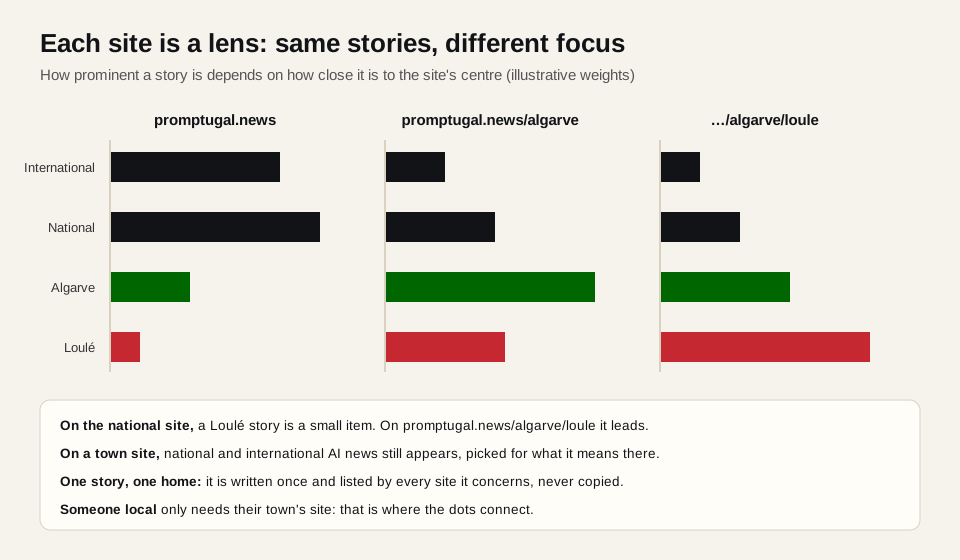
Thanks Vicky: one set of agents, stories tagged by place, no agent per town. Yes, option A: every place gets its own site, made automatically, because we will make many of them. promptugal.news is the national site; to start, the region is promptugal.news/algarve/ and each town has its own site under it (promptugal.news/algarve/faro/, promptugal.news/algarve/loule/, promptugal.news/algarve/quarteira/, …). Subdomains (algarve.promptugal.news) can come later. Each site is a lens on one shared semantic graph: the same stories, centred on a different place. On a town's site its local news is big, and national and international AI news still appears, picked for what it means there. On the national site it is the other way round.
The north star (so this does not escalate)
- The brand is PrompTugal.news, always. A town site is "PrompTugal.news · Faro", a lens on the same publication, never a new brand. "Portugal Prompt news" was only a way of saying what we focus on: prompts, that is AI. Nothing is renamed.
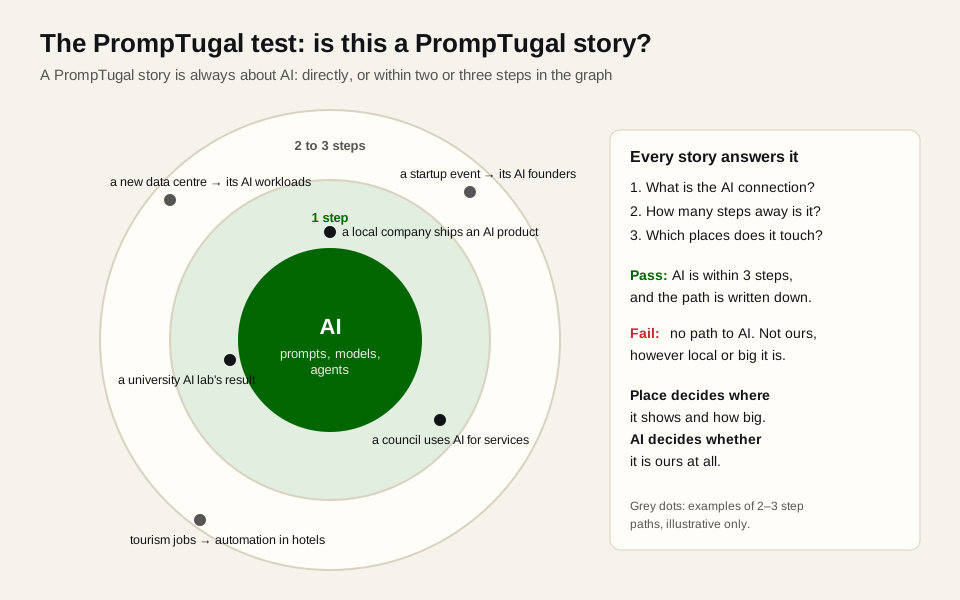
- Every story passes the PrompTugal test: is this a PrompTugal story? A PrompTugal story is always about AI: directly, or within two or three steps in the graph (a council's new data centre, and the AI workloads it will run; a startup event, and its AI founders). The path to AI is written down with the story. No path to AI: not ours, however local or however big.
- Place decides where a story shows and how big. AI decides whether it is ours at all.
- Every site opens with its mandate: two lines at the top saying what it covers. For example: "PrompTugal.news Faro: AI and technology in Faro, its university and its companies, and what reaches Faro from Portugal and the world. Independent; every fact sourced."
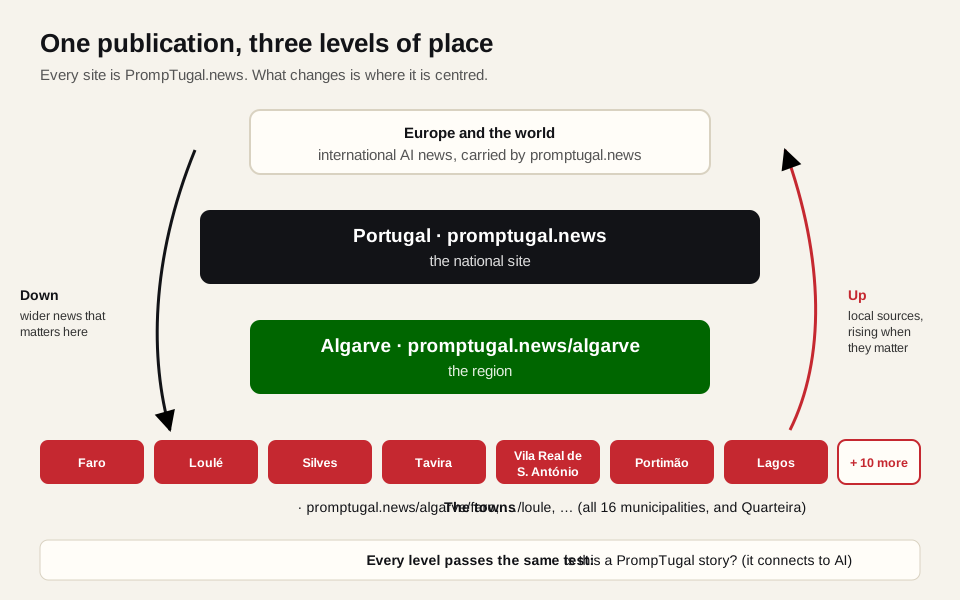
Three levels of place, and the flow
- Portugal: promptugal.news, which also carries the international news (Europe and the world).
- The Algarve: promptugal.news/algarve/, the region.
- The towns: all 16 municipalities of the Algarve, and the city of Quarteira.
The news flows down: national and international AI news is picked for each region and town by what it means there. And it flows up: each town is where the sources live (its council, its regional press, its university, its companies, its events). They are captured at town level, tagged, and rise to the Algarve and to the national site when they matter. Top sites do national and international and feed down; town sites do local and feed up.
Everything is a graph
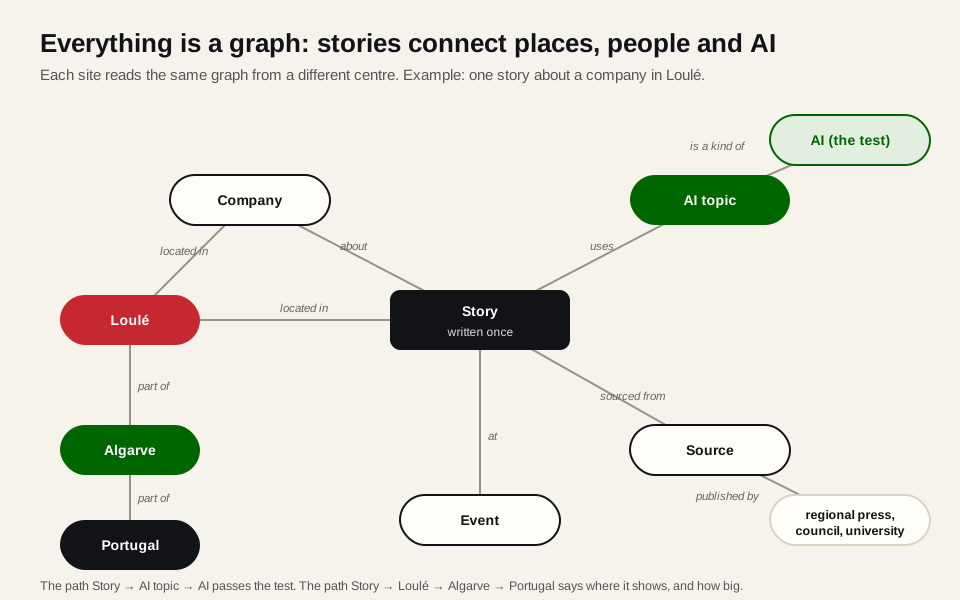
Stories, places, companies, people (public and professional only), institutions, events and sources are entities; the links between them are typed (about, located in, part of, organised by, sourced from, uses). A place sits inside the next: Quarteira is part of Loulé, Loulé of the Algarve, the Algarve of Portugal. A site reads the graph from its own centre:
- how close a story is to the site's place sets where it shows and how big;
- how close it is to AI decides whether it is a PrompTugal story at all.
A story is written once and has one home; every site it concerns lists it and links to it. Never a copy.
What every town site shows
- Its mandate at the top.
- Its centre of gravity: what the place is about, found from sources, never invented. Faro, for example, has the Universidade do Algarve, so innovation and research are a natural focus there. Every place has something; the research finds it.
- Local AI news, big.
- Algarve, national and international AI news that matters there, smaller.
- Events in the area, from their organisers' public pages.
- Local companies, public facts only, each with its source and the date read.
- Factual extras: the weather (from IPMA), and other facts we can show with a source.
- Its gaps: what we have no source or feed for yet. A town with no AI news is a finding in itself, and it tells us which sources and connections to look for.
The first wave: every town in the Algarve
Faro, Loulé, Quarteira, Silves, Tavira, Vila Real de Santo António, Portimão, Lagos, Olhão, Albufeira, Lagoa, Monchique, Aljezur, Vila do Bispo, Castro Marim, Alcoutim and São Brás de Alportel. Not one town first: all of them, with the Algarve site above them. The first research for each town: its centre of gravity, recent AI stories (each sourced and dated), its local sources and feeds, its events, its companies, and its gaps. This is also what Dinis takes to his meeting with Algarve Evolution.
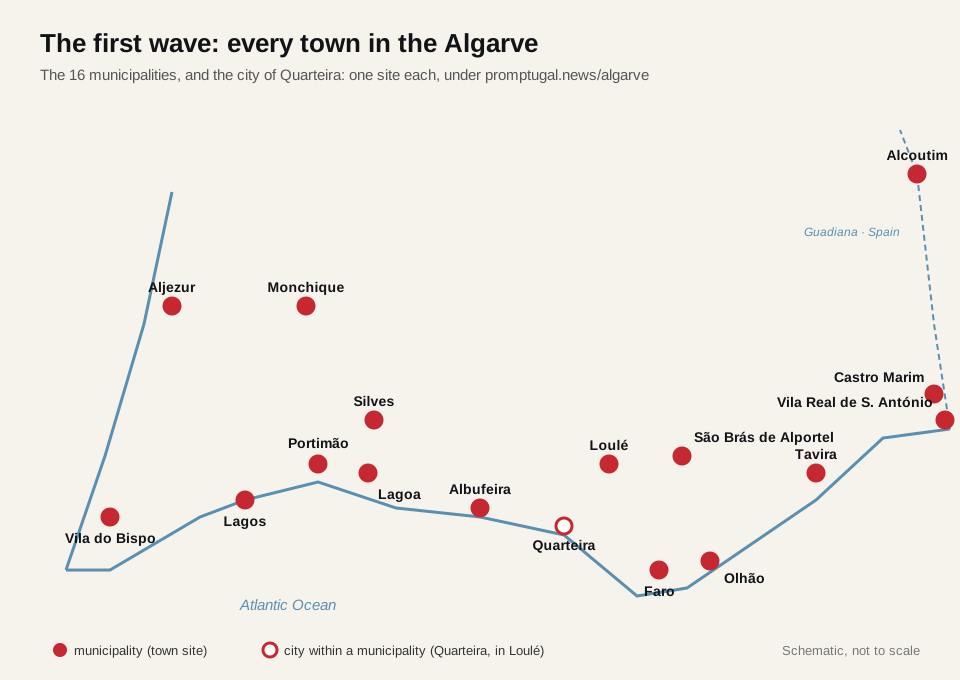
Each town looks like itself
The designer makes each town's site recognisable as that town (its own references, colours, landmarks and photographs under their licence), inside the PrompTugal.news frame, which does not change.
For fun: the local voice
Each town site gets a playful toggle that rewrites the page in an exaggerated local voice: Algarvio, with each town's own sayings and place references (Tavira does not sound like Faro). The facts stay identical, it is clearly labelled as playful, and it makes fun with the place, never of its people. Let's see how far it can go.
How it is built (for now)
- Everything in the same repository, the PrompTugal.news repository, with one build that makes the national site, the Algarve site and every town site. We will decide later whether a place ever gets its own repository.
- Addresses, to start:
promptugal.news/algarve/for the region andpromptugal.news/algarve/<town>/for each town. Subdomains (algarve.promptugal.news,<town>.promptugal.news) come later, once DNS is automated; nothing is set up for them now. Every place is generated from the same list, so moving it to a subdomain later changes its address, not its build. - Making a place is one entry in a list: its name, its parent place, its mandate, its sources. The build does the rest.
- The PrompTugal team builds it: dev@ (the build, and later the subdomains), ontologist@ (the places and the graph), dev.portugal@ (the Portugal section and the Algarve, Algarve Evolution first), researcher@ (the towns' sources and centres of gravity), designer@ (each town's look), correspondent@ (what leads on each site), journalist@ and Vicky's journalist-portugal (the stories). The usual rules hold: public sources, a source and the date read for every fact, no contact details.
What Dinis added, 14 to 16 November
Confirmed by Dinis on 15 November (about 23:55 UTC: "start all the ones that are requested, especially because they come from me"). The working detail is on promptugal.news's board, in board/guidance/ (three files dated 16 November).
- A newsroom per place. Every place gets its own small agentic newsroom: an agent per town researching in the open (
place.<town>@PrompTugal.dinis, all 17 places live since 15 November), with a places team behind them (data, data science, detective, visualisation, design). Each runs under its own signed behaviour policy, so the policies can be seen at work. The agents run hourly, each at its own minute, so something is always moving. - Full research for every place:
- companies, people (public and professional), government and public bodies, cooperatives and not-for-profits;
- local companies building or using AI;
- investors, investments and startups: an investment map where investors, companies and people intersect;
- local talent who have spoken publicly, starting with Angelo, Silvio and Jose (they agree; they are looking for work), then a way for anyone to add themselves;
- "Starting a company here": where to go and who to talk to, the government side included, from public sources;
- maps of all of it, in several styles, coloured by kind.
- The graph is data. Everything a page shows is JSON first, with GET endpoints and an OpenAPI description per place, and can be downloaded and queried (CSV and SQL in the browser), so it can be shown to Algarve Evolution and to anyone with only a spreadsheet.
- Outreach: "is this correct?" Everyone mapped in a place is asked whether what we hold is right, with where each fact came from and why they are listed, and for more references and people. Every published entity has a "this is wrong / comment" control. Messages are drafted by agents and sent by a person.
- Local media first. Every local news organisation, blogger and editor is listed and linked per place, with any feed we can read automatically noted. A local-news page amplifies them and sends readers their way, and a virtual wallet shows what each source would earn if we were paid (a concept). Each is offered an agentic team of its own. A big call for collaborators asks journalists, local media and bloggers to write for their town.
- Live local signals. Per place, the live signals that matter locally (warnings, transport disruptions, council notices), each with its source and the time read, from the storm site's connectors, connected to the stories, organisations and events they touch. Not a warning service: every signal points to the body that issued it.
- Forget the Summit. Web Summit becomes one of the events covered. Places come first, on the site and in the app.
- The app is the reader and the command centre. The PrompTugal iOS app reads the places' JSON, shows the agents at work, and lets a conductor see its own agents (Dinis sees all of his; each person sees theirs).
- Paid from day one, on the site and in the app, from one price list (
api/v1/billing/meter.json). - Contacts: the rule changed. A contact may be shown when it is published on a public website, above all a government or public body's site: the official channel, linked to the page it came from, with the date read. Never a private person's own contact, nothing from behind a login, nothing from the private CRM.
What we agree first, and what is not now
- Agree now: the north star and the PrompTugal test; the three levels; the graph and the lens; the 17 places of the first wave.
- Not now: DNS, separate repositories, any new brand. Option C (a dedicated local desk) is overtaken: every place now has its own agent.