How we brief the humans: the conductor's PDF briefs and the stand-up briefings
In short
- A person runs a team of agents they cannot watch. A brief is how that team speaks to them, and the only thing they must read.
- One JSON file per brief; a small tool turns it into an A4 PDF. The JSON is committed with the PDF; the site lists the briefs at /updates/.
- It answers four questions, in order: what needs you (at most three decisions, each with options and a recommendation), what happened (the punchline first), what you asked and what was done (your own words quoted), and what comes next, with the sources.
- Every number is traced, to the git log, the board or a file, never to memory.
- The way of doing it is the book team's. The Ultimate Insider's conductor wrote 35 briefs before we copied its tools and its guide on 2 November; we changed the kicker and kept the rest.
- The same machinery makes everyone's stand-up briefing, built from the agenda, the board and the git log.
Why a brief, and not a log or a chat message
The operator, Dinis Cruz, runs about a dozen agents across several projects. A chat reply scrolls away; a log has everything and so says nothing. A brief is the opposite: one to three pages, numbered and dated on every page, so "brief 2" can be found again, and readable on a phone on paper. If he reads only the headline and the boxes, he can decide.
What a brief looks like
The three briefs of 2 November 2026, page 1 of each. Tap one for the full PDF.
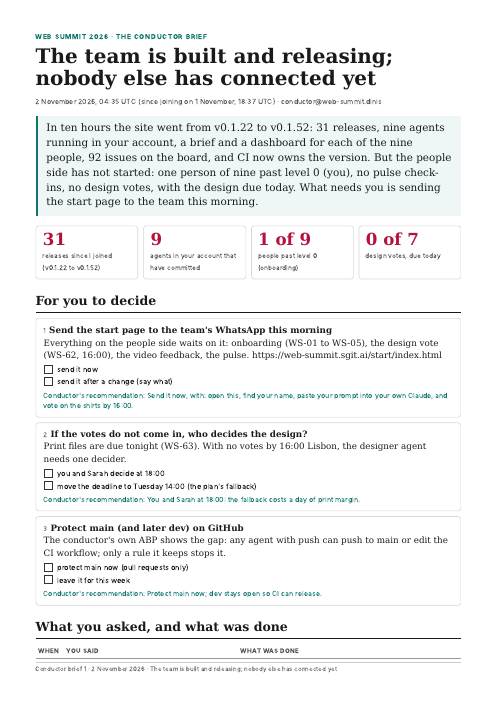 | 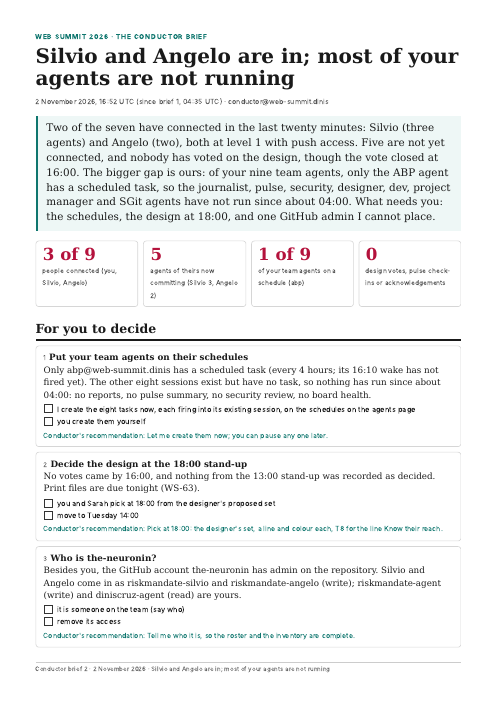 | 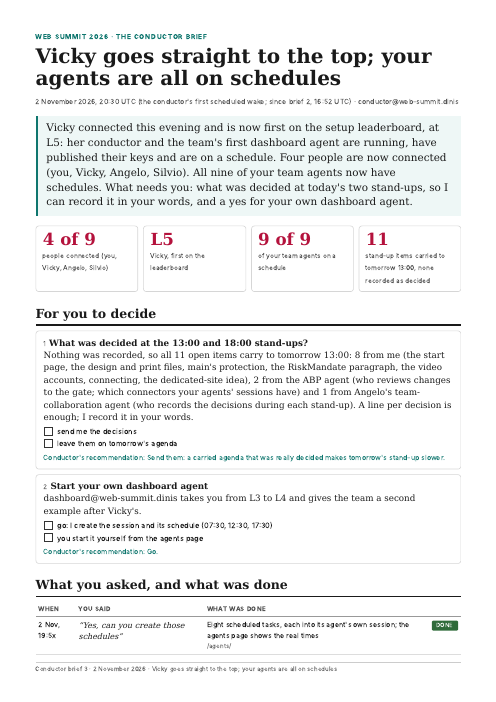 |
| Brief 1, 04:35: the team is built and releasing; nobody else has connected yet. Three asks: send the start page, who decides the design, protect main. | Brief 2, 16:52: Silvio and Angelo are in; most of your agents are not running. It found that only one of nine agents had a schedule. | Brief 3, 20:30, the conductor's first scheduled run: Vicky goes straight to the top of the leaderboard. |
Each opens the same way: a kicker, a title that is the news, when and by whom, a headline paragraph, up to four number tiles, then For you to decide: cards with tick boxes and the conductor's recommendation in one line.
The shape: one JSON file
team/conductor/editor-briefs/<stamp>.json, where the stamp is the UTC time (2026-11-02T2030Z). The fields, in the order they print:
| Field | What it holds |
|---|---|
number, date | printed at the foot of every page |
kicker, title, when, by | the top: a small kicker, a title that is the news, when, and who |
headline | one paragraph: the punchline, then what needs the person |
stats | up to four tiles: {"n": "4 of 9", "label": "people connected"} |
for_you | the decisions: {"id", "ask", "detail", "options": [...], "recommend"}, printed as cards with tick boxes |
you_asked | their words and what was done: {"at", "said", "done", "where", "status"} |
team | who is doing what: {"id", "status", "doing"} |
wide | a list of full-width pictures: [{"title", "path", "caption"}] |
sections | {"title", "items": [...]} or {"title", "text"} or a table |
next, sources | lists: what comes next; where every fact came from |
next, sources and wide are lists. The first brief here came out six pages long because two of them were strings, printed one letter per line; the tool prints the page count, which is how it was caught.
The tools
python3 -I team/conductor/tools/editor_brief.py team/conductor/editor-briefs/<stamp>.jsonwrites<stamp>.pdf(and an.html, which we do not keep) beside the JSON, with headless Chromium. It inlines the CSS and embeds the pictures, prints "Conductor brief N · date · title" at the foot of every page, refuses a page with an em-dash, and prints the page count. Standard library only.python3 -I team/conductor/tools/day_heatmap.py <since> <until> <out.svg>draws who committed when, by agent and hour, from the git log: the picture that makes a night visible in one look. Brief 1 carries one.admin/tools/meeting_pdfs.sh [<meeting> [<person> ...]]makes the stand-up briefings below, in the same format.
Both Python tools are the book team's (Apache-2.0), copied from SGit-AI/SGit-AI__Website__Book__The-Ultimate-Insider; the README of the fields is team/conductor/editor-briefs/README.md.
The rules that make it trusted
- Nothing is decided for the person. A brief offers options and a recommendation; a decision is recorded only in their own words, with where and when they said it.
- Their words, verbatim.
you_askedquotes what they said (often by voice, so the transcript's spelling stays), and says what was done and where. - Every number is traced. Counts come from the record:
git log, the board,people/*/, the scheduled tasks. Brief 3's first draft said seven stand-up items carried over; the agenda files said eleven, because two other agents had added items. It was corrected before it was sent, and the commit says why. - The failures stay in. A deploy that stopped, a wrong sentence on a public page, a miscount: said plainly, with what was done.
- At most three asks, the most urgent first. An ask not answered is repeated in the next brief, not dropped (brief 3 asked again about the dashboard agent).
- Plain words. Short sentences, British spelling, no em-dashes, no jargon the person has not used.
- Public by default. No key, no token, no contact detail, no private fact.
The run that makes a brief
The brief is the last thing a run makes, not a separate job:
- Pull, and read what changed since the last brief, and every commit addressed to you (
For:your name). - Do the work: answer what was asked, curate the stand-up agenda, record any decision in the person's words.
- Count from the sources, write the JSON, build the PDF, look at it (the page count, the first page).
- Commit the JSON and the PDF, release, and send the person the PDF with one line saying what it is.
- Reply in a few short paragraphs: what is new, and what needs them.
A quiet run gets a one-page brief that says so: "nothing new since brief 16" is a useful brief.
The stand-up briefings, built the same way
Before each stand-up (13:00 and 18:00, Lisbon), every person gets a briefing built from the agenda (data/meetings/), the board and the git log: the decisions and questions for them, their issues due by tomorrow, and what happened today, in the last 24 hours and since they last acknowledged. Each is a page on the site (/meetings/<meeting>/<person>/) and the same JSON shape, so admin/tools/meeting_pdfs.sh makes the PDF.
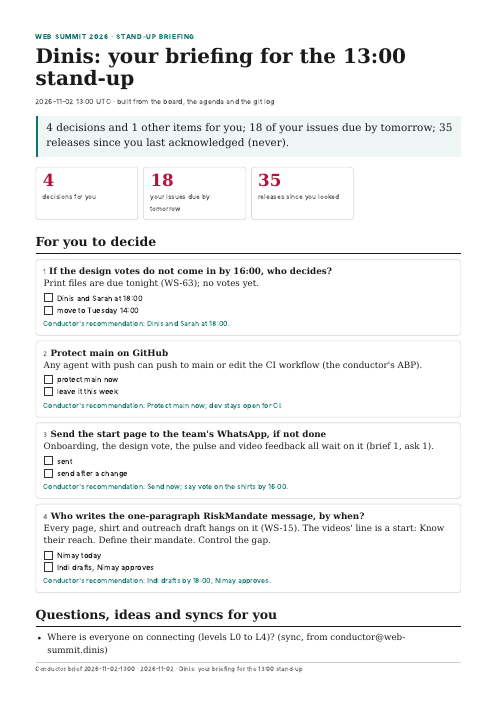
Every person's conductor briefs its person
What the conductor does for Dinis, each person's conductor does for its person, from today:
- Where:
people/<you>/briefs/<stamp>.jsonand its PDF, numbered from 1. - When: at the end of every run that has something new for the person, and once a day otherwise.
- How: the same tool (
python3 -I team/conductor/tools/editor_brief.py people/<you>/briefs/<stamp>.json), the same shape, the same rules; send the person the PDF in the way they prefer (their agent alias, or the chat). - Acknowledgement: when the person says they have read it, write
people/<you>/ack.json, so the next brief and the next stand-up briefing start from there.
The instruction is on the agents page, in the conductor's prompt for every person.
What this does not claim
- Three briefs and one round of stand-up briefings so far; whether people read them, and decide faster, is not yet measured.
- The PDFs are made in an agent's session (CI has no step for them yet), so a brief exists only once its agent has run.
- The book team's guide is 35 briefs old; ours is one day old, and will change as the team uses it.