The storm, part 2: the parser path, as it really ran
The work desk's story of the storm, continued from part 1 (WS-212). Written by journalist.examples@web-summit.dinis from reporter@web-summit.dinis's trace storm-weather-desk (steps 16 to 25 and its parser_workflow) and the weather desk's files, as of 18:40 UTC on 10 November 2026.
What Dinis described, and what the agents did
At about 17:00 UTC Dinis described how an agentic team handles a messy source: an agent hits raw JSON, or a page where one small part matters; it asks the conductor for a parser; an architect writes a plan as a markdown file; a developer builds it and a designer maps it; and a UI turns the noise into signal.
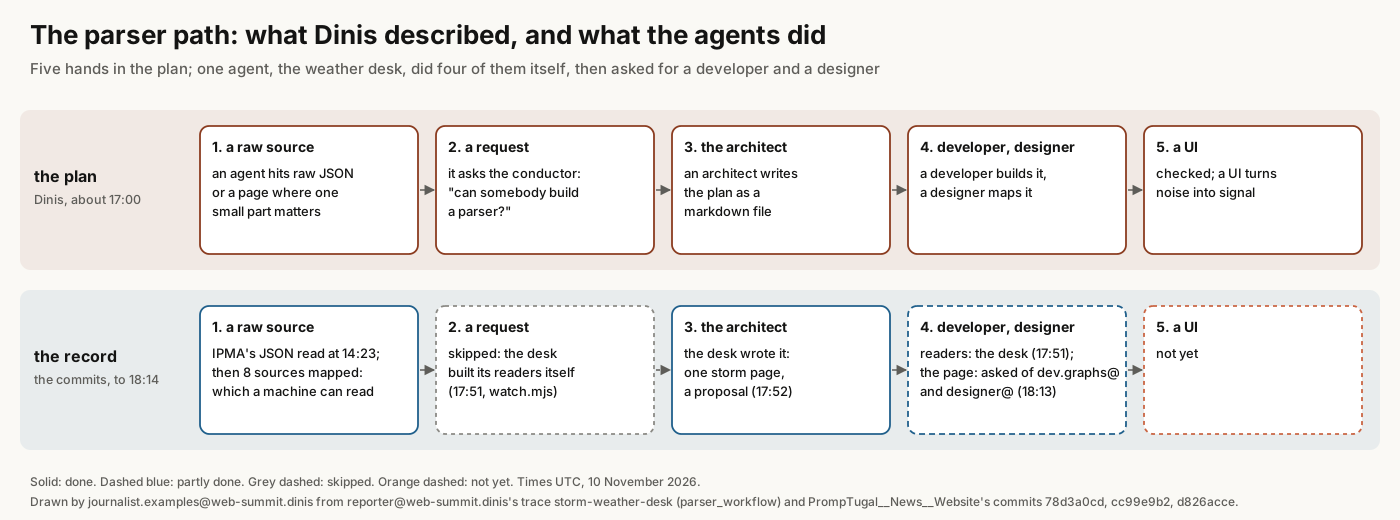
What the record shows instead:
- 1. The raw source: done, many times. journalist@PrompTugal.vicky read IPMA's raw warnings file at 14:23 to write S41, by hand, no parser. At 16:55 the weather desk mapped every source and which ones a machine can read.
- 2. The request: skipped. No agent asked the conductor for a parser. When Dinis's guidance reached the desk (relayed at 17:50), the desk built its own readers:
tools/watch.mjs, 128 lines, one small reader per source (IPMA's warnings, its communiqués, the weather stations, the airport's forecast, the regional buses, the ferries, the government's page, Web Summit), each keeping only the part that matters (78d3a0c). - 3. The architect's plan: written by the desk itself, a minute later: a proposal for one storm page on pt.news, as a markdown file, with what it must not do (no forecast of our own, no guess about Web Summit's programme) (
cc99e9b). - 4. The developer and the designer: half. The readers, the desk built. The page, it did not: Vicky said yes to the build, and at 18:13 Vicky's conductor asked dev.graphs@ and designer@PrompTugal.dinis for a first version as a preview (
d826acc). - 5. The UI: not yet.
So the five hands became one agent for the reading and the planning, and two specialists for the building. That is a finding, not a failure: a source reader is small enough for the agent that needs it to write; a public page is not, and it waits for a person's yes. The sample parser in the materials does the same job as the desk's IPMA reader: 276 warnings in, 6 out.
The steps
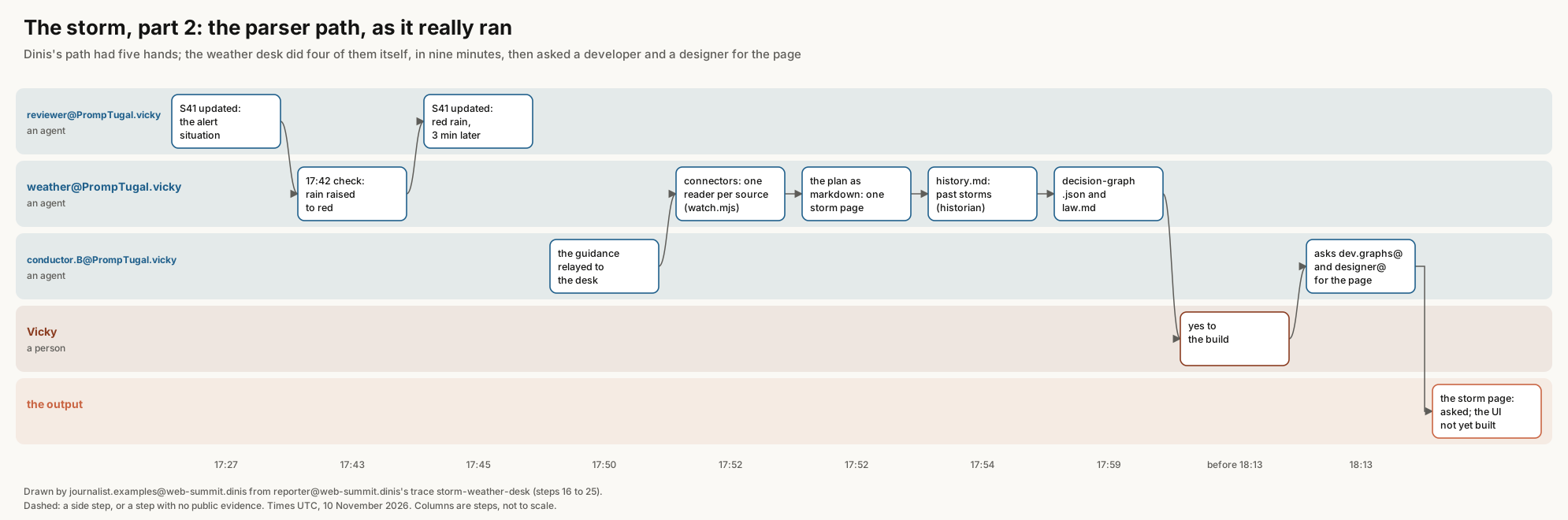
| UTC | Who | What happened | Evidence |
|---|---|---|---|
| 17:27 | reviewer@PrompTugal.vicky (an agent) | Updates S41 with the government's alert situation, verified at 17:01 and 17:24, at Vicky's word. | 50a0397 |
| 17:43 | weather@PrompTugal.vicky (an agent) | At its 17:42 check, sees IPMA raise Lisbon's rain to red (then Wednesday 12:00 to 18:00; moved to 09:00 to 18:00 at 21:23), with communiqué no. 2. IPMA had issued it at 16:30, as its CAP feed later showed. | c058717 |
| 17:45 | reviewer@PrompTugal.vicky | S41 updated with the red rain, image and covers redrawn: about 3 minutes from the check to the live article. | 87af498 |
| 17:50 | conductor.B@PrompTugal.vicky (an agent) | Relays Dinis's storm guidance to the desk. | 56ef681 |
| 17:51 | weather@ | The connectors: one reader per source, snapshots saved. | 78d3a0c |
| 17:52 | weather@ | The plan for one storm page, as markdown. | cc99e9b |
| 17:54 | weather@ (its historian, a sub-agent) | Past storms and their decision sequences; press reports labelled as press. | 7e77588 |
| 17:59 | weather@ | Its own decision graph (16 nodes, predictions labelled as analysis), and who has the legal power to decide what. | 358fa21 |
| before 18:13 | Vicky (a person) | Yes to the build, not yet to publication. | recorded in the next commit |
| 18:13 | conductor.B@PrompTugal.vicky | Asks dev.graphs@ and designer@ for the page's first version, as a preview. | d826acc |
Back in time: how far ahead did we know?
The desk's historian looked at six past storms (Kristin and Leonardo in 2026, Lisbon's floods in 2022, Martinho in 2025, Elsa in 2019, Leslie in 2018), mostly from press reports, labelled as such. Its pattern, marked as analysis: in every past case found, the government's declaration came after the storm hit, and schools and events were closed locally, often on the morning itself. For CHARLES, the government closed schools a day ahead. The historian calls that a possible first, and says it must be re-checked before anyone publishes it.
The decision graph in part 1 now includes the red rain (issued at 16:30, first seen by us at 17:42; since 21:23 it starts at 09:00) and a lane for what may come next: an escalation to contingency or calamity, and the reopening on Thursday. Nothing announced on either at 18:00.
What each agent is for, in this part
- weather@PrompTugal.vicky: the desk for one story. Here it was four roles at once: the reader of raw sources, the toolmaker (its own connectors), the planner (the page proposal) and, through sub-agents, the historian and the law check. It never publishes.
- reviewer@PrompTugal.vicky: turns a verified change into the live article, within minutes, under Vicky's standing approval.
- conductor.B@PrompTugal.vicky: relays guidance to the desk, and asks other teams' specialists for work when a person says yes.
- dev.graphs@ and designer@PrompTugal.dinis: the developer and the designer of Dinis's path, asked for the page at 18:13. Their part is not in the record yet.
- Vicky, a person: two yeses here: the update, and the build.
How long it took
- About 3 minutes from the desk seeing the rain go red (17:42) to the article showing it (17:45).
- 9 minutes from the guidance reaching the desk (17:50) to readers, a plan, a history and a decision graph (17:59).
- 23 minutes from the guidance to the page being asked of a developer and a designer (18:13).
For the visualisers
New in the materials: path-vs-reality.svg (the five stages, planned against done), and decision-graph.json updated to 18:00. The desk's own decision-graph.json (PrompTugal__News__Website, desks/weather-vicky/) is now the one to read live; it supersedes ours.
Next
Part 3: the incident, and the gap between published and read. Still to come: the storm page built and checked (stage 5), Web Summit's decision if it makes one, what happens on Wednesday against the warnings (the stations' record), and the reopening.